IN THE UNITED STATES DISTRICT COURT FOR THE NORTHERN DISTRICT OF ILLINOIS EASTERN DIVISION VICTORIO PELLICANO, Plaintiff, No. vs. LUCID BOTS, INC.; ANDREW ASHUR; MARK McDOWELL; PHILIP CARSON; and CHRIS HALLIGAN, Defendants.
COMPLAINT
Plaintiff Victorio Pellicano, by and through his undersigned attorneys at Dentons US LLP, for his Complaint alleges as follows:
NATURE OF THE ACTION
This action arises from Defendants’ failure to provide Plaintiff Victorio Pellicano with equity compensation promised for his service as Chief AI Officer and President of Defendant Lucid Bots, Inc. (“Lucid Bots”), his termination after he rejected Defendants’ effort to reduce and net that compensation against his preexisting equity holdings, and Defendants’ subsequent false statements concerning his professional conduct. Defendant Andrew Ashur is Lucid Bots’ founder, Chief Executive Officer, and a director; Defendants Mark McDowell and Philip Carson are directors and compensation committee members who negotiated and communicated the President equity package; and Defendant Chris Halligan is a director who participated in and delivered the termination decision. Mr. Pellicano asserts claims arising from the unpaid equity compensation and business-expense
reimbursements,
retaliatory termination,
fraudulent
inducement,
interference with his contractual rights, and reputational harm, and seeks damages, statutory and equitable relief, specific performance, declaratory relief, and an accounting.
INTRODUCTION
By late 2025, Defendant Lucid Bots was in trouble. Its prior Series B financing had failed, sales had stalled, and recurring revenue was zero. The Company’s Board turned to Victorio Pellicano—an experienced technology entrepreneur who founded two companies that were later acquired, including an AI robotics company Lucid Bots itself acquired—for help. To recruit Mr. Pellicano, the Company promised him substantial equity compensation. Lucid Bots first promised him equity compensation for serving as the Company’s Chief AI Officer, including additional equity upon the next financing round. Separately, Mr. Pellicano was already an equity holder in the Company through prior investments and the acquisition of Avianna, LLC. Mr. Pellicano’s existing investor and acquisition-related holdings, as well as the initial CAIO equity grant the Company issued, are undisputed. After Mr. Pellicano made immediate and obvious progress in turning the Company around, the Board asked him to take on the role of President. Compensation committee members Mark McDowell and Philip Carson promised him a separate President package: 7.225% of the Company’s fully diluted equity as an immediate grant, plus a 2% earn-in. That package was additive—not to be netted against Mr. Pellicano’s existing investor and acquisition-related holdings.
Mr. Pellicano delivered. Over approximately fourteen months of full-time service—including approximately six months as President—he assumed substantial operational responsibility, developed and implemented Lucid Refresh, the Company’s recurring-revenue subscription model, and closed the Company’s first subscription generating $40,000 in annual recurring revenue. During his tenure, the pace of sales roughly doubled, and recurring revenue grew from zero to approximately 30% of the Company’s revenue. Because recurring revenue commands multiples far higher than hardware sales, that shift raised enterprise value on the order of ten times per revenue dollar. Lucid Bots ultimately closed more than $12 million in Series B financing at a $103 million valuation. Mr. Pellicano organized and led a Sydecar SPV that invested approximately $205,000 in that round pursuant to a SAFE dated on or about September 15, 2025. Approximately $25,000 of that amount was Mr. Pellicano’s own capital; the remainder came from investors Mr. Pellicano personally recruited based on the business plan and financials management provided and on his own credibility. Those same investors now face the reputational harm Defendants have inflicted on Mr. Pellicano.
Once the Series B closed, however, Lucid Bots tried to renege on the deal. The Company did not issue either the financing-triggered equity top-up or the promised President grant. On April 10, 2026, McDowell proposed only 3.075% in new options by subtracting Mr. Pellicano’s existing 4.15% investor holdings from the agreed 7.225% immediate President grant. The proposal contradicted the additive structure reflected in the written offer letter and the parties’ contemporaneous agreements and communications. Mr. Pellicano rejected the reduced proposal on April 13. A few weeks later, Lucid Bots terminated him without identifying any cause. That evening, Chief Executive Officer Andrew Ashur told the Company’s employees that “[t]he gap between what Vic was hoping for and what the company can grant while reserving enough equity to bring on more future Lucidians for this expedition was too large to close,” confirming that Lucid Bots preferred to terminate Mr. Pellicano rather than honor its promises.
To make matters worse, after Mr. Pellicano challenged the Company’s failures and his termination, the Company began disparaging him to third parties and falsely claiming that he had a conflict of interest with a third-party entity that he neither controlled nor received compensation from.
Lucid Bots benefited from the substantial operational turnaround and financing that Mr. Pellicano’s work and leadership helped achieve. It must now honor the compensation commitments that induced that work—and answer for its subsequent efforts to disparage him.
PARTIES
I. Plaintiff
Plaintiff Victorio Pellicano is an individual and a citizen of Illinois. He resides in Homer Glen, Illinois. During the relevant period, he performed substantial work for Lucid Bots from Illinois.
Mr. Pellicano is a highly accomplished technology executive, entrepreneur, and investor with a proven track record of building and scaling technology companies. He founded Verenia, which Oracle Corporation acquired in approximately January 2022. At Oracle, Mr. Pellicano earned over $540,000 annually. He left Oracle in 2023. He subsequently founded Avianna, LLC, an AI robotics startup. His background includes deep expertise in artificial intelligence, autonomous systems, product development, and enterprise sales. Multiple investors in Lucid Bots’ Series B financing identified Mr. Pellicano’s operational leadership as material to their investment decision.
II. Defendants
Defendant Lucid Bots, Inc. is a Delaware corporation with its principal place of business at 6601A Northpark Boulevard, Charlotte, North Carolina 28216. Lucid Bots is an AI robotics company that manufactures and sells drones and robots for exterior cleaning, construction, and related commercial uses.
Defendant Andrew Ashur is the founder, Chief Executive Officer, and a board member of Lucid Bots. On information and belief, Ashur is a citizen of North Carolina. Ashur participated in the conduct alleged in this Complaint, including the Company’s financial reporting, investor-facing communications, refusal to honor Mr. Pellicano’s equity compensation, termination-related communications, and post-termination statements concerning Mr. Pellicano.
Defendant Mark McDowell is a board member of Lucid Bots and a member or co- chair of the Company’s compensation committee. McDowell is associated with Charlotte Fund. On information and belief, McDowell is a citizen of North Carolina. McDowell participated directly in the January 2026 President equity promise, the April 2026 communications acknowledging and then re-trading that promise, and the May 2026 decision to terminate Mr. Pellicano.
Defendant Philip Carson is a board member of Lucid Bots and a member or co- chair of the Company’s compensation committee. Carson is associated with Cubit Capital, which co-led or substantially participated in Lucid Bots’ financing. On information and belief, Carson is a citizen of Texas. Carson participated directly in the January 2026 President equity promise, the Company’s compensation committee process, the Series B financing, and the May 2026 decision to terminate Mr. Pellicano.
Defendant Chris Halligan is a board member of Lucid Bots and is associated with Good Human Investments or Good Human Investment Partners. On information and belief, Halligan is a citizen of North Carolina. Halligan participated in the May 8, 2026 termination call, on which he delivered the termination decision. Halligan previously met with Mr. Pellicano on April 23, 2026 and stated in substance that the parties were “like 2 percentage points off from one another.”
On May 5, 2026, Halligan left a voicemail concerning a draft “company proposal” that was being walked through Carson, McDowell, Ashur, and the board before presentation to Mr. Pellicano.
Defendants Ashur, McDowell, Carson, and Halligan are referred to collectively as the “Individual Defendants.”
JURISDICTION AND VENUE
This Court has subject-matter jurisdiction under 28 U.S.C. § 1332 because the parties are citizens of different states and the amount in controversy exceeds $75,000, exclusive of interest and costs.
Complete diversity exists. Mr. Pellicano is a citizen of Illinois. Lucid Bots is a citizen of Delaware and North Carolina. On information and belief, none of the Individual Defendants is a citizen of Illinois.
The amount in controversy exceeds $75,000. Mr. Pellicano seeks damages arising from promised equity worth millions of dollars, statutory damages, penalties, attorneys’ fees, costs, equitable relief, and damages arising from tortious and defamatory conduct.
This Court has personal jurisdiction over Defendants because Defendants purposefully directed employment, compensation, financing, termination, and defamatory conduct toward Illinois; entered or caused Lucid Bots to enter compensation agreements with an Illinois resident; accepted substantial performance from an Illinois resident; communicated with Mr. Pellicano in Illinois about his compensation, equity grants, and termination; and caused injury in Illinois.
Ashur, McDowell, Carson, and Halligan each directed communications to Mr. Pellicano in Illinois concerning his compensation, performance, termination, or post-termination characterization, and each participated in decisions intended to affect Mr. Pellicano’s Illinoisbased employment and compensation rights.
Lucid Bots repeatedly treated Mr. Pellicano’s employment relationship as governed by Illinois law. The November 4, 2025 offer letter is governed by Illinois law. The May 8, 2026 termination letter likewise stated that Mr. Pellicano would receive his final paycheck in accordance with Illinois law.
Venue is proper in this District under 28 U.S.C. § 1391 because a substantial part of the events and omissions giving rise to the claims occurred in this District. Mr. Pellicano resided and worked in Illinois during the relevant period. Defendants directed communications, promises, compensation decisions, and termination-related actions to him in Illinois. The injury was suffered in Illinois. The Northern District of Illinois is the appropriate forum for this dispute.
The Eastern Division is proper because Mr. Pellicano resides within the Northern District of Illinois and performed substantial work for Lucid Bots from this District.
FACTUAL ALLEGATIONS
I. Mr. Pellicano’s Relationship With Lucid Bots Began as an Investor, Director, and Founder of an Acquired AI Robotics Company
Mr. Pellicano’s relationship with Lucid Bots began before he became an employee.
In approximately 2022, after Oracle acquired Verenia, the company he founded, Mr. Pellicano invested in Lucid Bots through a SAFE.
In 2023, Mr. Pellicano invested additional capital in Lucid Bots.
Mr. Pellicano’s $100,000 SAFE converted into Series A-1 preferred shares.
Mr. Pellicano also made an additional direct Series A investment.
The purchase agreement for those 10,713 Series A shares names Pelican Investment Group, LLC as the buyer, but the stock certificate was issued in Mr. Pellicano’s name.
The Company’s current cap table will confirm which entity is of record.
In approximately December 2023, Mr. Pellicano joined the Lucid Bots board of directors at Andrew Ashur’s request.
Lucid Bots granted Mr. Pellicano director options in connection with that role.
In approximately 2024, Lucid Bots acquired Avianna, LLC, an AI robotics startup founded by Mr. Pellicano.
As part of that acquisition, Mr. Pellicano’s holding entity received Lucid Bots common stock.
Mr. Pellicano was not an employee of Lucid Bots when that acquisition occurred.
These pre-employment holdings mattered because they were investor, director, and acquisition-related holdings.
The pre-employment holdings were not compensation for the later executive work Defendants asked Mr. Pellicano to perform as Chief AI Officer and then President. II.
Lucid Bots knew that distinction.
Lucid Bots later memorialized that distinction in writing. Lucid Bots Recruited Mr. Pellicano to Join Full Time With Below-Market Cash Compensation in Exchange for Equity
In approximately March 2025, Lucid Bots convinced Mr. Pellicano to join the Company full time as Chief AI Officer, or “CAIO.”
The Company offered him a base salary of $175,000.
That cash salary was far below market for an executive of Mr. Pellicano’s background, experience, and prior earnings.
Mr. Pellicano had previously earned over $540,000 annually at Oracle.
Mr. Pellicano accepted Lucid Bots’ reduced cash compensation because the Company promised equity that would allow him to participate meaningfully in the value he was being asked to create.
As CAIO, Mr. Pellicano built Lavo AI, the Company’s autonomous rover product.
Mr. Pellicano contributed technical, operational, and executive work that materially advanced the Company’s business.
On April 15, 2025, McDowell sent an email to Mr. Pellicano and Ashur stating that Lucid Bots had agreed Mr. Pellicano would receive the same option award as another executive for joining as CAIO and that the award would be followed by a one-time top-up after the Series B for anti-dilution.
Ashur responded approvingly and encouraged the team to build the most valuable company.
That April 15, 2025 exchange demonstrates that the Company understood Mr. Pellicano’s executive compensation grants were additive to his existing holdings.
Lucid Bots was not treating his investor, director, or acquisition-related equity as a credit against executive compensation.
III. The Written Offer Letter Promised a CAIO Equity Grant and a Separate CAIO Refresh Grant
On November 4, 2025, Mr. Pellicano executed the operative written offer letter with Lucid Bots. A true and correct copy of the November 4, 2025 Offer Letter is attached hereto as Exhibit A and incorporated herein by reference.
The offer letter promised two equity grants. The first was a CAIO Equity Grant of 95,011 options. The second was a CAIO Refresh Grant under Section 2(b)(ii), which required Lucid Bots to issue additional options upon the next equity financing so that the CAIO Equity Grant plus the CAIO Refresh Grant would equal 1.744% of the Company’s fully diluted capitalization after the financing.
The offer letter expressly excluded Mr. Pellicano’s other equity from that calculation, including his Series A-1 stock, Series A preferred stock held through Pelican Investment Group, LLC, and Avianna common stock.
The offer letter therefore confirmed the anti-netting structure that Lucid Bots had already adopted in its course of dealing with Mr. Pellicano.
On November 5, 2025, Lucid Bots issued Mr. Pellicano a stock option grant for 95,011 shares at a $2.15 strike price.
That grant reflected the CAIO Equity Grant.
Lucid Bots also issued a separate option grant for 32,249 shares with a vesting commencement date tied to Mr. Pellicano’s earlier director service.
The 32,249-share grant re-papered the December 2023 director option grant after a Section 409A cleanup.
The 32,249-share grant was director compensation, not CAIO employment equity.
Lucid Bots cannot properly use the 32,249-share director grant, or Mr. Pellicano’s investor or acquisition-related equity, to offset the CAIO Refresh Grant.
The offer letter’s text forecloses that netting argument.
The next equity financing occurred when the Series B closed in or around February 2026. That closing triggered Lucid Bots’ obligation to issue the CAIO Refresh Grant.
Lucid Bots did not issue the CAIO Refresh Grant.
The resulting shortfall is approximately 53,779 shares or more, subject to confirmation through discovery and the Company’s cap table.
If the 1.744% target is measured on the fully diluted count including the new shares themselves, the shortfall approaches 54,700 shares.
IV. Lucid Bots Was in Crisis When the Board Asked Mr. Pellicano to Take Over as President
By late 2025, Lucid Bots faced obvious and significant operational challenges.
The Company had attempted but failed to complete a prior Series B financing.
Sales were flat to declining.
Recurring revenue was effectively zero.
The Company was burning cash.
Ashur was largely absent because of a family matter.
Against that backdrop, the Lucid Bots board needed an operating executive who could stabilize the business and restore credibility.
Around November 2025, the board asked Mr. Pellicano to assume the role of President.
He did so based on the board’s assurance that his compensation would be addressed promptly and fairly.
Mr. Pellicano took on substantial operational responsibility.
Mr. Pellicano helped manage cash and operations.
Mr. Pellicano supported fundraising.
Mr. Pellicano developed and implemented Lucid Refresh, a recurring-revenue model that converted hardware sales into a subscription-oriented platform.
Mr. Pellicano closed the Company’s first subscription generating $40,000 in annual recurring revenue, demonstrating the viability of a model the board had doubted could be achieved on that timetable.
Mr. Pellicano’s work produced measurable results. During his tenure, the pace of sales roughly doubled, and recurring revenue grew from zero to approximately 30% of the Company’s revenue.
Because recurring revenue commands multiples far higher than hardware sales, that shift raised enterprise value on the order of ten times per revenue dollar.
Lucid Bots also closed more than $12 million in Series B financing at an approximately $103 million post-money valuation.
Mr. Pellicano organized and led a Sydecar SPV that invested approximately $205,000 in that round pursuant to a SAFE dated on or about September 15, 2025.
Approximately $25,000 of that amount was Mr. Pellicano’s own capital; the remainder came from investors Mr. Pellicano personally recruited based on the business plan and financials management provided and on his own credibility.
Multiple investors identified his continued operational role as material to their investment decisions.
On March 6, 2026—approximately nine weeks before his termination—Ashur conducted Mr. Pellicano’s performance review. Ashur rated Mr. Pellicano 3.92 out of 4.00, an “Exceptional Impact” score. A true and correct copy of the March 6, 2026 Performance Review is attached hereto as Exhibit B and incorporated herein by reference.
Ashur’s written summary stated that Mr. Pellicano “consistently operate[d] above expectations.” The review identified Mr. Pellicano’s title as “President & Chief Platform Officer.”
That evaluation underscores that Mr. Pellicano delivered on his commitments and that Lucid Bots terminated him not for performance reasons but because he refused to accept a diminished equity package.
V. The Compensation Committee Promised Mr. Pellicano a 9.225% Fully Diluted President Equity Package
In January 2026, McDowell and Carson were members or co-chairs of the Lucid Bots compensation committee.
On information and belief, Lucid Bots’ board authorized McDowell and Carson, acting through the compensation committee, to negotiate Mr. Pellicano’s President equity package within the expanded employee option pool and subsequently approved or ratified the resulting package, including through the January 28, 2026 action item directing that the promised options be sent to outside counsel for documentation.
Lucid Bots ratified their agreement by accepting Mr. Pellicano’s continued performance, instructing outside counsel to prepare additional option-grant paperwork, and later proposing a reduced grant rather than denying that a grant was owed.
On December 17, 2025, McDowell and Mr. Pellicano met for dinner at O-Ku restaurant in Charlotte, North Carolina.
During that dinner, McDowell told Mr. Pellicano that McDowell would like to get Mr. Pellicano to 20% of the Company’s fully diluted capitalization, but that it “may be outside of your control.”
The following day, December 18, 2025, Mr. Pellicano sent McDowell an email with the subject line “Great Dinner.” The email thanked McDowell for the dinner and recapped Mr. Pellicano’s contributions.
The email stated: “You mentioned you’d like to get me to 20%, but that it may be ‘outside of your control.’”
This contemporaneous written communication memorialized McDowell’s oral representation.
On January 7, 2026, Mr. Pellicano emailed Carson and McDowell after a compensation conversation.
Mr. Pellicano thanked them for the discussion and stated that he was looking forward to seeing the text memorializing the offer from them.
On January 8, 2026, Carson responded that the next step was for McDowell and Carson to present the compensation arrangement to the board, after which an offer would be made.
On January 8, 2026, McDowell further confirmed that the compensation committee had responsibility for the matter and that Mr. Pellicano’s compensation was “entangled” with the financing round.
McDowell explained that the employee stock option pool would be increased as part of the financing and that Mr. Pellicano’s new options would be drawn from that pool. A true and correct copy of McDowell’s January 8, 2026 ESOP Email is attached hereto as Exhibit C and incorporated herein by reference.
On January 16, 2026, during a compensation committee call attended by McDowell, Carson, and Mr. Pellicano, Lucid Bots offered, and Mr. Pellicano accepted, an equity compensation package for the President role.
The compensation committee offered Mr. Pellicano half of Ashur’s post-round stake as an immediate grant, plus an additional 2% earn-in at 0.5% per year over four years.
McDowell’s own subsequent text messages confirmed that the target was “50% of Andrew’s level,” and when calculated against Ashur’s post-round 14.45% stake, this translated to 7.225% in immediate operator equity plus the additional 2% earn-in.
The total President equity package therefore consisted of 9.225% of the Company’s fully diluted capitalization.
The 7.225% immediate operator grant represented approximately half of Ashur’s post-round 14.45% stake.
That structure reflected the central commercial reality of the bargain: Mr. Pellicano was being asked to assume operating leadership of a company in crisis and would receive nearfounder-level economics for doing so.
The President equity package was additive to Mr. Pellicano’s existing investor, director, and acquisition-related holdings. It was not to be netted against those holdings.
The President equity package was to be sourced from the post-financing employee stock option pool increase.
That structure was consistent with McDowell’s January 8, 2026 email and the Company’s anti-netting treatment of the CAIO Refresh Grant.
Mr. Pellicano accepted the President equity package and continued performing as President. Lucid Bots accepted that performance.
The Company did not promptly issue the grant paperwork. Defendants delayed while Mr. Pellicano continued working and creating value.
VI. The Company’s Own Communications Confirmed That an Additional President Grant Was Owed
On January 28, 2026, at a Lucid Bots board meeting, meeting notes reflected an action item that someone would send outside counsel the promised options offline.
That action item corroborated that promised options existed and needed to be papered.
The Series B closed in or around February 2026. That financing closed with the benefit of Mr. Pellicano’s operational work, investor-facing credibility, and continued service.
Even after the Series B closed, Lucid Bots did not issue the CAIO Refresh Grant or the President equity package.
On April 4, 2026, Ashur sent Mr. Pellicano a Slack direct message in response to a question about compensation committee work on salary.
Ashur’s message contained a parenthetical reference: “(Outside of the options work we did).”
That parenthetical—with no share count, FD percentage, or grant name—treated the President equity grant as work that had already been completed and was awaiting paperwork.
On April 9, 2026, at approximately 5:02 a.m., Mr. Pellicano texted McDowell.
Mr. Pellicano stated that he had never received actual paperwork on the deal that McDowell and Carson had made with him in January.
Mr. Pellicano asked to review the language when a proposal was available so that things would go smoothly.
Later that morning, at approximately 7:22 a.m., McDowell responded by text.
McDowell confirmed that the additional option grant was a top priority.
McDowell stated that the Company had asked Silicon Legal Strategy, Lucid Bots’ outside corporate counsel, to prepare the paperwork for Mr. Pellicano’s additional option grant.
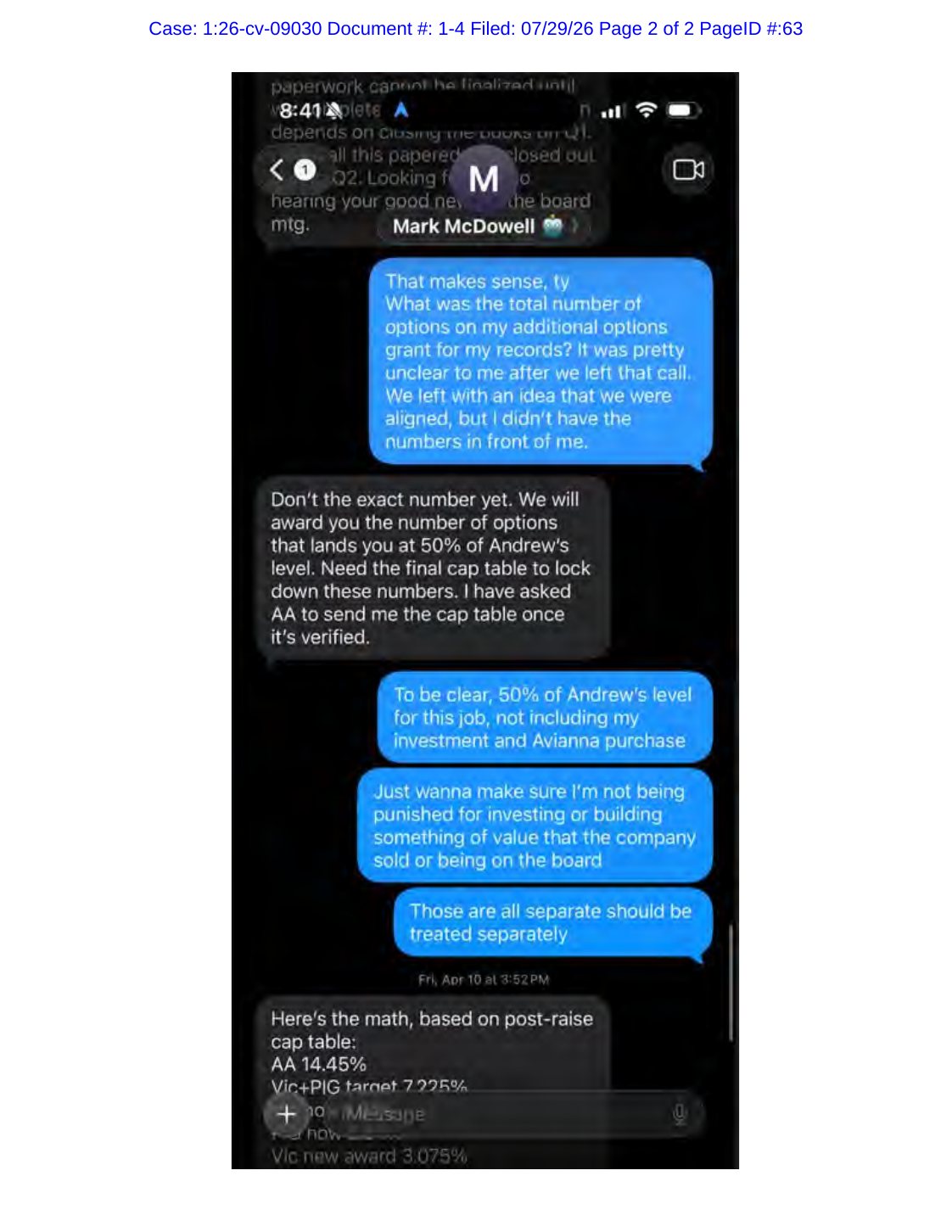
McDowell stated that the paperwork could not be finalized until completion of the 409A valuation, which depended on closing the books for the first quarter. A true and correct copy of the April 9–10, 2026 McDowell Text Messages is attached hereto as Exhibit D and incorporated herein by reference.
McDowell’s April 9 text was an admission by a compensation committee member that an additional option grant existed, that the Company had instructed outside counsel to paper it, and that the only stated delay was valuation timing.
Mr. Pellicano then asked what the total number of options would be for his records.
The exact option count corresponding to the agreed percentage had not been supplied after the January call.
In response, McDowell confirmed that the target was the number of options that would land Mr. Pellicano at 50% of Ashur’s level.
McDowell’s statement confirmed the core economic term of the January 16 promise.
Later on April 9, 2026, Mr. Pellicano sent three consecutive text messages to McDowell confirming that the grant was additive and should not net against his prior investments or acquisition-related holdings.
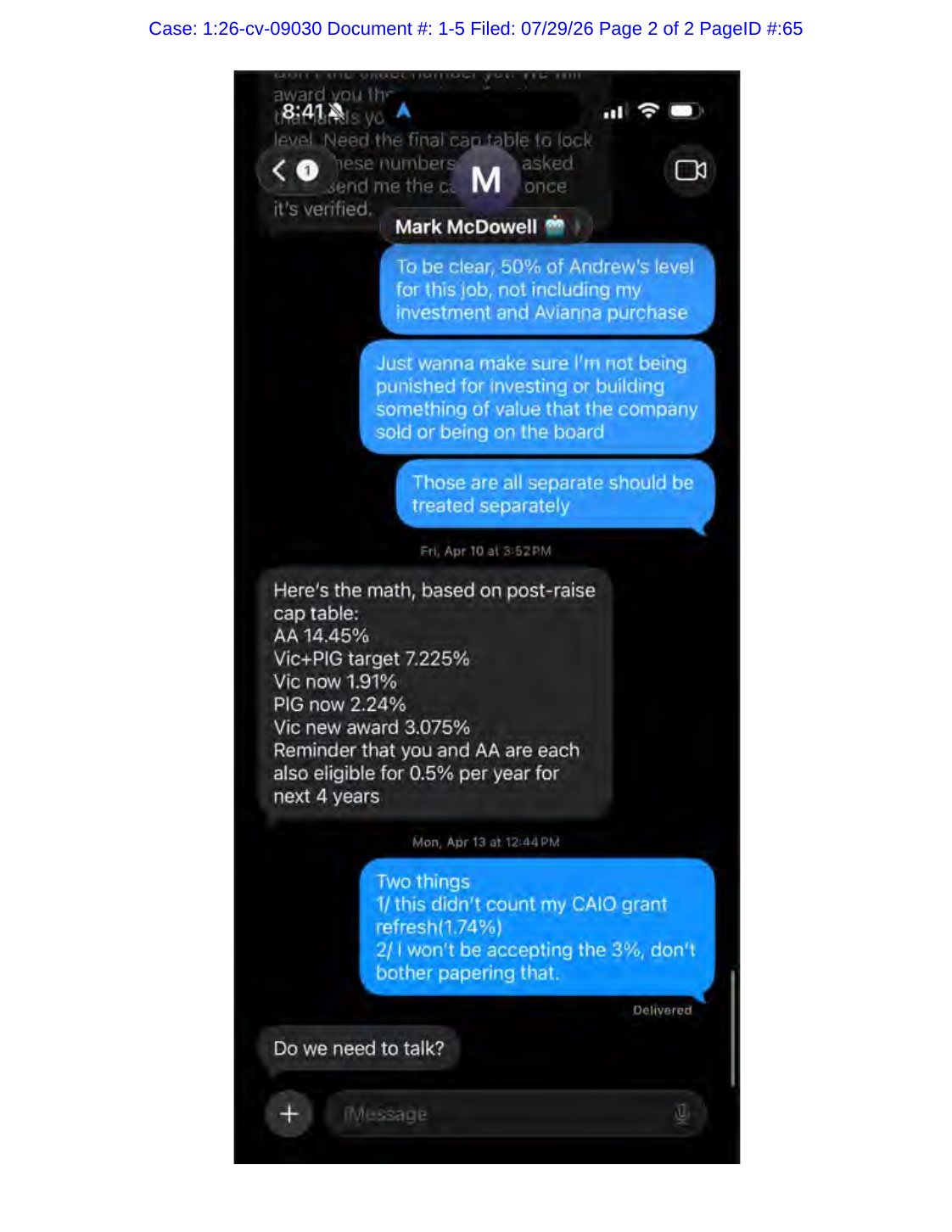
Mr. Pellicano stated: “To be clear, 50% of Andrew’s level for this job, not including my investment and Avianna purchase.”
Mr. Pellicano continued: “Just wanna make sure I’m not being punished for investing or building something of value that the company sold or being on the board.”
Mr. Pellicano concluded: “Those are all separate should be treated separately.”
McDowell did not reply to contest this framing.
Approximately thirty-two hours after Mr. Pellicano’s three text messages rejecting any netting approach, on April 10, 2026 at 3:52 p.m., McDowell sent a materially different proposal.
The proposal offered only 3.075% in new options.
The proposal reached that diminished number by subtracting Mr. Pellicano’s existing 4.15% holdings from the 7.225% immediate operator equity target.
McDowell’s silence during the intervening thirty-two hours—followed by a proposal that performed exactly the netting Mr. Pellicano had explicitly forbidden—demonstrates that McDowell understood Mr. Pellicano’s position and deliberately disregarded it.
That was the exact netting structure Mr. Pellicano had rejected. It was contrary to the offer letter’s anti-netting structure, the January 8 ESOP-sourcing email, the January 16 promise, the April 9 clarification, and the commercial reason Lucid Bots had asked Mr. Pellicano to assume the President role.
Lucid Bots’ April 10 proposal is nevertheless an admission that additional equity was owed. The Company did not say that no President grant existed. It proposed a reduced grant.
On April 13, 2026, Mr. Pellicano rejected the netted proposal in writing. He stated: “Two things / 1/ this didn’t count my CAIO grant refresh (1.74%) / 2/ I won’t be accepting the 3%, don’t bother papering that.” A true and correct copy of Mr. Pellicano’s April 13, 2026 Rejection Text is attached hereto as Exhibit E and incorporated herein by reference.
McDowell responded by asking whether they needed to talk. The Company did not issue the promised equity. It did not honor the CAIO Refresh Grant. It did not honor the President equity package.
VII. Lucid Bots Fired Mr. Pellicano Because He Refused to Accept the Re-Traded Equity Deal
On April 23, 2026, Mr. Pellicano and Ashur met. Action items included resolving equity. On that same general timeline, Lucid Bots directors and officers were discussing how to respond to the compensation dispute.
On April 30, 2026, the board met. The equity dispute was not resolved.
On May 5, 2026, Halligan left a voicemail concerning a draft “company proposal” that was being walked through Carson, McDowell, Ashur, and then the board, before presentation to Mr. Pellicano.
On May 8, 2026, at approximately 12:30 p.m. Eastern time, Lucid Bots terminated Mr. Pellicano during a video call.
Mr. Pellicano took the call from outside a hospital approximately 200 miles from his home, where his daughter was receiving emergency medical care during her pregnancy.
The termination call included Halligan, Carson, McDowell, and Katie Purcell, the Company’s Director of People Operations. Ashur was not on the call.
During the termination call, Lucid Bots stated in substance that it could not properly compensate Mr. Pellicano, that the compensation committee did not want to negotiate, and that the decision was unanimous.
Those stated reasons confirm that Mr. Pellicano was fired because he refused to accept Defendants’ improper effort to net and reduce his equity compensation.
At approximately 12:40 p.m. Eastern time on May 8, 2026, Lucid Bots issued a termination letter signed by Purcell. The letter stated that Mr. Pellicano’s employment was terminated effective May 8, 2026.
The letter did not identify cause.
The letter stated that Mr. Pellicano would receive his final paycheck in accordance with Illinois law.
The letter stated that his access to Company systems would be disabled as of the separation date. A true and correct copy of the May 8, 2026 Termination Letter is attached hereto as Exhibit F and incorporated herein by reference.
Lucid Bots immediately cut off Mr. Pellicano’s access to Company email and
When Lucid Bots terminated Mr. Pellicano, two business expense reimbursement Slack. requests he had submitted through Ramp were still pending: $269.05 for Cursor (a software subscription, submitted mid-2025) and $4,318.92 for Amazon “Engineering Learnings” materials (submitted early May 2026).
These reimbursements totaled $4,587.97.
Mr. Pellicano captured the Ramp record on May 28, 2026 before losing access.
Lucid Bots has not paid these reimbursements.
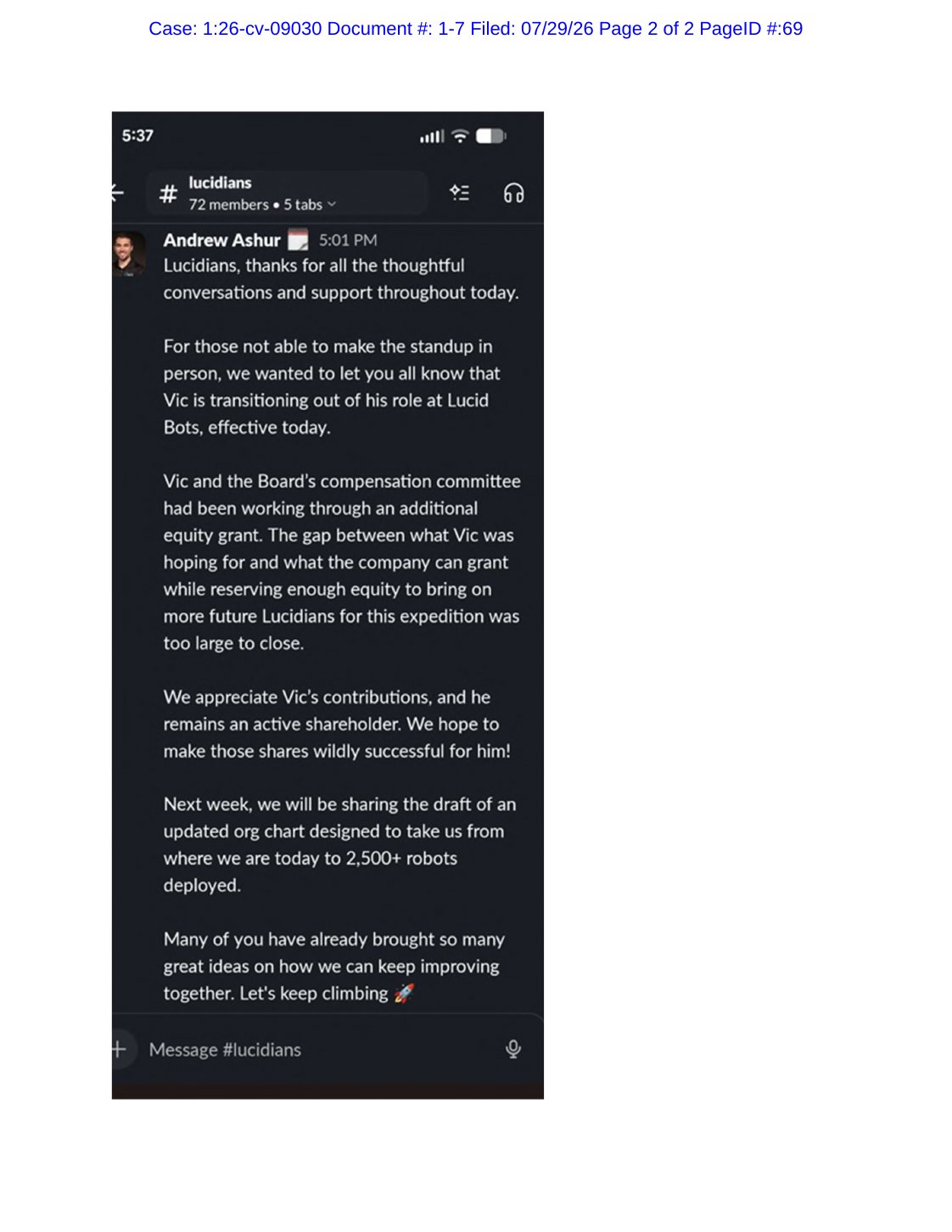
At approximately 5:01 p.m. Eastern time on May 8, 2026, Ashur posted an internal Slack message to the #lucidians channel, which had approximately 72 members.
Ashur wrote that Mr. Pellicano was transitioning out of his role at Lucid Bots effective that day.
Ashur stated that Mr. Pellicano and the board’s compensation committee had been working through an additional equity grant.
Ashur further stated that “[t]he gap between what Vic was hoping for and what the company can grant while reserving enough equity to bring on more future Lucidians for this expedition was too large to close.” A true and correct copy of the May 8, 2026 Ashur Slack Message is attached hereto as Exhibit G and incorporated herein by reference.
Ashur’s Slack message was a Company admission. It confirmed that the termination was caused by the equity dispute. It also mischaracterized Mr. Pellicano’s contractual rights as mere hopes.
On or about May 11, 2026, Lucid Bots delivered a proposed separation agreement dated May 8, 2026.
The separation agreement offered a lump sum severance payment of only $14,588.33, limited COBRA coverage, and acceleration of certain option shares.
The separation agreement required Mr. Pellicano to release his claims, waive his equity rights, resign from the board, covenant not to sue, agree to arbitration in Charlotte, North Carolina, and accept other restrictive terms. A true and correct copy of the May 8, 2026 Separation and Release Agreement is attached hereto as Exhibit H and incorporated herein by reference.
The separation proposal would have required Mr. Pellicano to release millions of dollars in equity compensation rights. Mr. Pellicano did not sign it. VIII. Defendants Tried to Manufacture Pretext and Harm Mr. Pellicano’s Reputation
After firing Mr. Pellicano for refusing to accept the diminished compensation package, Defendants attempted to manufacture a post hoc justification for their conduct.
On information and belief, Defendants have asserted, published, or caused others to assert and publish that Mr. Pellicano had a conflict of interest, diverted business, breached agreements, breached duties owed to Lucid Bots, or engaged in misconduct involving another entity.
Those accusations are false. Mr. Pellicano did not divert Lucid Bots business. He did not have the alleged conflict.
In fact, the commercial relationship between Lucid Bots and that entity was established and managed by Lucid Bots’ own management: Mr. Pellicano signed neither of the governing contracts, did not supervise the contractor’s work, and approved none of the contractor’s time.
Mr. Pellicano did not engage in misconduct that justified the Company’s refusal to pay his compensation.
On information and belief, Defendants made these statements to one or more board members, Lucid Bots employees, investors, business partners, prospective business partners, and other third parties.
Defendants made the statements to injure Mr. Pellicano’s reputation, deter him from enforcing his rights, undermine his credibility with investors and the robotics market, and conceal Defendants’ own misconduct.
The statements are defamatory per se because they impute a lack of integrity and ability in Mr. Pellicano’s profession and accuse him of conduct incompatible with his role as an executive, entrepreneur, director, investor, and robotics operator.
IX. Mr. Pellicano’s Damages
The Series B post-money valuation was approximately $103 million.
That valuation implies a price of approximately $12.07 per share on approximately 8,531,533 fully diluted shares, subject to confirmation in discovery.
The November 5, 2025 CAIO Equity Grant carried an exercise price of $2.15 per
The exercise price applicable to the unissued CAIO Refresh Grant and President share. equity package remains subject to the parties’ agreements, the applicable equity plan and valuations, and discovery. A true and correct copy of the Series B Pro Forma Cap Table is attached hereto as Exhibit I and incorporated herein by reference.
The CAIO Refresh Grant shortfall is approximately 53,779 shares or more, subject to confirmation through Lucid Bots’ cap table and option ledger.
If the 1.744% target is measured on the fully diluted count including the new shares themselves, the shortfall approaches 54,700 shares.
The President equity package included 7.225% in immediate operator equity and an additional 2% grant to be issued at the same time, subject to vesting at 0.5% per year over four years.
At Series B pricing, the gross value of the full package exceeded $8 million, before adjustment for vesting, exercise price, security class, financing preferences, and other applicable factors.
The Series B financing provides one relevant valuation reference point.
The appropriate measure of damages remains subject to the applicable exercise price, vesting terms, security class, financing preferences, valuation date, and other evidence obtained in discovery.
Mr. Pellicano is entitled to compensatory damages, statutory damages, prejudgment interest, attorneys’ fees, costs, specific performance, declaratory relief, reputational damages, punitive damages where available, and all other relief permitted by law.
INJURIES TO PLAINTIFF
Defendants’ conduct directly and proximately caused Mr. Pellicano’s injuries.
As a direct and proximate result of Defendants’ breaches, misrepresentations, retaliation, and tortious conduct, Mr. Pellicano suffered damages including the loss of the CAIO Refresh Grant, valued at approximately 53,779 option shares or more.
Mr. Pellicano lost the 7.225% immediate President grant and the opportunity to receive and continue vesting in the additional 2% grant.
At Series B pricing, the gross value of the full package exceeded $8 million, subject to adjustment for exercise price, vesting, tax treatment, security class, financing preferences, valuation date, and any equitable relief ordered by the Court.
Mr. Pellicano suffered lost vesting and liquidity benefits that would have accompanied timely issuance of the promised equity.
Mr. Pellicano suffered statutory damages and penalties available under the Illinois Wage Payment and Collection Act.
Mr. Pellicano is owed $4,587.97 in unpaid business expense reimbursements that were pending in the Company’s Ramp expense system when he was terminated.
Mr. Pellicano suffered harm to his professional reputation in the technology, robotics, and venture capital communities.
Mr. Pellicano suffered lost professional opportunities.
Mr. Pellicano has incurred and will continue to incur attorneys’ fees and litigation
Mr. Pellicano suffered emotional distress and related consequential damages. costs.
CAUSES OF ACTION
COUNT I — BREACH OF WRITTEN CONTRACT(CAIO REFRESH GRANT) (PLAINTIFF AGAINST LUCID BOTS, INC.)
Mr. Pellicano incorporates by reference and realleges the preceding paragraphs as if fully set forth herein.
Under Illinois law, to prove a breach of contract claim, the plaintiff must show that: (1) a valid and enforceable contract exists; (2) the plaintiff substantially performed the contract; (3) the defendant breached the contract; and (4) the plaintiff suffered damages as a result of the breach. Burkhart v. Wolf Motors of Naperville, Inc., 2016 IL App (2d) 151053, ¶ 14; W.W. Vincent & Co. v. First Colony Life Ins. Co., 351 Ill. App. 3d 752, 759 (1st Dist. 2004).
The November 4, 2025 offer letter is a valid and enforceable written contract between Mr. Pellicano and Lucid Bots.
The offer letter is governed by Illinois law.
Mr. Pellicano performed his obligations under the offer letter and all conditions precedent to Lucid Bots’ performance occurred or were excused.
The offer letter required Lucid Bots to issue the CAIO Equity Grant of 95,011 options and, upon the next equity financing, the CAIO Refresh Grant necessary to bring the CAIO Equity Grant plus the CAIO Refresh Grant to 1.744% of the Company’s fully diluted capitalization after the financing.
The Series B financing closed in or around February 2026. That financing triggered Lucid Bots’ obligation to issue the CAIO Refresh Grant.
Lucid Bots breached the offer letter by failing and refusing to issue the CAIO Refresh Grant.
Lucid Bots also breached the offer letter by attempting to net Mr. Pellicano’s investor, director, and acquisition-related holdings against executive compensation that the offer letter treated separately.
As a direct and proximate result of Lucid Bots’ breach, Mr. Pellicano suffered damages in an amount to be proven at trial, including the value of approximately 53,779 option shares, consequential damages, prejudgment interest, attorneys’ fees and costs where available, and other relief.
COUNT II — BREACH OF ORAL AND IMPLIED-IN FACT CONTRACT(PRESIDENT EQUITY PACKAGE) (PLAINTIFF AGAINST LUCID BOTS, INC.)
Mr. Pellicano incorporates by reference and realleges the preceding paragraphs as if fully set forth herein.
On January 16, 2026, Lucid Bots, acting through its compensation committee members McDowell and Carson, offered Mr. Pellicano an equity compensation package for continuing to serve as President and performing the associated operational, fundraising, and executive responsibilities.
The President equity package consisted of 9.225% of the Company’s fully diluted capitalization. It included 7.225% as an immediate operator equity grant and an additional 2% grant to be issued at the same time but subject to vesting at 0.5% per year over four years.
The President equity package was additive and was not to be netted against Mr. Pellicano’s existing investor, director, or acquisition-related holdings.
Mr. Pellicano accepted the offer. He continued performing as President. He provided valuable executive, operational, strategic, fundraising, and product work for Lucid Bots.
Lucid Bots accepted Mr. Pellicano’s performance and the benefits of that performance.
The parties’ agreement is enforceable under Illinois law. It was capable of performance within one year because Lucid Bots could issue the grant at any time, and Mr. Pellicano’s at-will employment relationship could terminate within one year.
The agreement is corroborated by written communications, including Mr. Pellicano’s December 18, 2025 email to McDowell memorializing McDowell’s statement that he wanted to get Mr. Pellicano to 20% FD, McDowell’s January 8, 2026 email concerning ESOPsourced options, the January 2026 compensation communications, Ashur’s April 4, 2026 Slack message treating the options work as completed, McDowell’s April 9, 2026 texts confirming that SLS had been asked to prepare the additional option grant, McDowell’s April 9, 2026 confirmation that the grant targeted 50% of Ashur’s level, Mr. Pellicano’s April 9, 2026 three consecutive texts confirming the additive structure, and Lucid Bots’ April 10, 2026 proposal conceding that additional equity was owed.
Lucid Bots breached the agreement by failing and refusing to issue the promised President equity package.
Lucid Bots further breached the agreement by attempting to issue only 3.075% in new options through an improper netting calculation that subtracted Mr. Pellicano’s existing holdings from the agreed 7.225% immediate operator equity target.
As a direct and proximate result of Lucid Bots’ breach, Mr. Pellicano suffered damages in an amount to be proven at trial, including the value of the promised President equity package, consequential damages, prejudgment interest, and other relief.
COUNT III — Illinois Wage Payment and Collection Act (PLAINTIFF AGAINST ALL DEFENDANTS)
Mr. Pellicano incorporates by reference and realleges the preceding paragraphs as if fully set forth herein.
The Illinois Wage Payment and Collection Act, 820 ILCS 115/1 et seq., requires employers to pay employees all earned wages, final compensation, and wage supplements due under an employment agreement or policy. 820 ILCS 115/2, 115/4, 115/5.
The Act provides for recovery of underpayments, statutory damages of 5% of the amount of any underpayments for each month following the date of payment during which such underpayments remain unpaid, costs, and reasonable attorneys’ fees. 820 ILCS 115/14(a).
The CAIO Refresh Grant and President equity package constitute compensation, wages, final compensation, and/or wage supplements owed to Mr. Pellicano under Lucid Bots’ written, oral, and implied agreements.
Lucid Bots also failed to reimburse $4,587.97 in necessary business expenses that Mr. Pellicano submitted through the Company’s Ramp system, as alleged above, in violation of 820 ILCS 115/9.5.
Lucid Bots is an employer within the meaning of the Act.
Mr. Pellicano was an employee within the meaning of the Act.
The Individual Defendants were officers, directors, compensation committee members, employer agents, or persons acting directly or indirectly in the interest of Lucid Bots in relation to Mr. Pellicano.
Under 820 ILCS 115/13 and 56 Ill. Admin. Code § 300.620, individual liability attaches to officers or agents who exercise sufficient control to allocate to whom or what entity funds are paid and in what amount during the relevant period.
The Individual Defendants knowingly permitted Lucid Bots to fail to pay earned compensation owed to Mr. Pellicano.
Under 56 Ill. Admin. Code § 300.620, “knowingly” means knowledge of the existence of facts constituting the alleged violation, rather than knowledge of the unlawfulness of the act or omission. “Permit” means to allow to happen or to fail to prevent, regardless of the corporation’s ability to pay.
Each Individual Defendant had knowledge that the CAIO Refresh Grant and President equity package were owed to Mr. Pellicano.
Each Individual Defendant participated in the decision to withhold those grants from Mr. Pellicano.
The compensation owed to Mr. Pellicano was due no later than the termination of his employment or the next regular payday following separation.
Lucid Bots failed and refused to pay the owed compensation.
As a result, Defendants are liable for the unpaid compensation, statutory damages, monthly penalties, prejudgment interest, attorneys’ fees, costs, and all other relief available under the Act.
COUNT IV — Retaliation Under the Illinois Wage Payment and Collection Act (PLAINTIFF AGAINST ALL DEFENDANTS)
Mr. Pellicano incorporates by reference and realleges the preceding paragraphs as if fully set forth herein.
Mr. Pellicano asserted his right to compensation owed by Lucid Bots.
Mr. Pellicano repeatedly requested the paperwork for his additional option grant.
Mr. Pellicano confirmed that the grant was additive.
Mr. Pellicano preserved his right to the CAIO Refresh Grant.
Mr. Pellicano rejected Defendants’ improper netted proposal.
Defendants knew Mr. Pellicano was asserting compensation rights.
Defendants terminated Mr. Pellicano a few weeks after he rejected the improper netted proposal in writing.
Defendants’ stated reasons for the termination confirm the causal connection between Mr. Pellicano’s assertion of compensation rights and the termination.
During the termination process, Lucid Bots stated in substance that the Company could not properly compensate him and that the compensation committee did not want to negotiate.
Ashur’s May 8, 2026 Slack message further confirmed that the termination was tied to the additional equity grant dispute.
Defendants retaliated against Mr. Pellicano for asserting his right to earned compensation.
As a direct and proximate result, Mr. Pellicano suffered damages, including lost compensation, lost benefits, lost equity value, reputational harm, emotional distress, statutory damages, attorneys’ fees, costs, and all other relief available under law.
COUNT V — Promissory Estoppel (PLAINTIFF AGAINST LUCID BOTS, MCDOWELL, AND CARSON)
Mr. Pellicano incorporates by reference and realleges the preceding paragraphs as if fully set forth herein.
This claim is pleaded in the alternative to Count I and Count II.
The Illinois Supreme Court has recognized promissory estoppel as an affirmative
cause of action. Newton Tractor Sales, Inc. v. Kubota Tractor Corp., 233 Ill. 2d 46, 51–53 (2009).
Under Illinois law, to establish a claim for promissory estoppel, the plaintiff must prove that: (1) defendant made an unambiguous promise to plaintiff; (2) plaintiff relied on such promise; (3) plaintiff’s reliance was expected and foreseeable by defendant; and (4) plaintiff relied on the promise to its detriment. Id. at 51; Quake Constr., Inc. v. Am. Airlines, Inc., 141 Ill. 2d 281, 310 (1990).
In the alternative to Count I and Count II, Lucid Bots, McDowell, and Carson made clear and unambiguous promises to Mr. Pellicano concerning his equity compensation.
Lucid Bots promised the CAIO Refresh Grant in the offer letter and through related communications.
Lucid Bots, McDowell, and Carson promised the President equity package in January 2026 and reaffirmed the existence of an additional grant in April 2026.
Defendants intended and reasonably expected Mr. Pellicano to rely on those promises by joining Lucid Bots full time, accepting below-market cash compensation, assuming the President role, continuing to operate and stabilize the Company, supporting the Series B financing, contributing investor capital, and foregoing other opportunities.
Mr. Pellicano reasonably relied on those promises.
Mr. Pellicano’s reliance was detrimental.
Mr. Pellicano performed months of executive work, delivered material value to Lucid Bots, supported the Company’s financing, and lost the compensation he was promised.
Injustice can be avoided only by enforcing Defendants’ promises or awarding the value of the promised compensation.
As a direct and proximate result of Defendants’ conduct, Mr. Pellicano suffered damages in an amount to be proven at trial.
COUNT VI — Fraudulent Inducement and Promissory Fraud (PLAINTIFF AGAINST LUCID BOTS, ASHUR, MCDOWELL, AND CARSON)
Mr. Pellicano incorporates by reference and realleges the preceding paragraphs as if fully set forth herein.
This claim is pleaded with the particularity required by Federal Rule of Civil Procedure 9(b).
Under Illinois law, common-law fraud requires: (1) a false statement of material fact; (2) knowledge or belief by the maker that the statement was false; (3) an intention to induce the plaintiff to act; (4) reasonable reliance upon the truth of the statement by the plaintiff; and (5) damage to the plaintiff resulting from this reliance. Connick v. Suzuki Motor Co., 174 Ill. 2d 482, 496 (1996).
Illinois law recognizes promissory fraud where a false promise is part of a scheme to defraud.
Promissory fraud claims are actionable when the fraud is one element of a pattern of fraudulent acts, and the scheme is intended to induce the promisee to act for the promisor’s benefit at the time of the promise.
Defendants’ conduct here was not an isolated broken promise.
Defendants’ conduct was a deliberate course of conduct in which Defendants induced Mr. Pellicano’s service and investor-facing support, accepted the benefit of that performance, delayed papering the promised compensation, attempted to re-trade the equity after the financing closed, and terminated him when he objected.
Defendants made material misrepresentations and omissions to induce Mr. Pellicano to join Lucid Bots full time, accept below-market cash compensation, assume the President role, continue working through the Series B financing, and contribute to the Company’s turnaround.
The misrepresentations were specific and are set forth below with the particularity required by Rule 9(b).
Beginning in or around March 2025 and continuing through October 2025, Ashur and other Lucid Bots representatives recruited Mr. Pellicano to join Lucid Bots full time as CAIO.
Ashur and other Lucid Bots representatives represented that Mr. Pellicano would receive meaningful executive equity compensation to offset his materially below-market cash salary.
These representations induced Mr. Pellicano to leave his prior opportunities and join Lucid Bots.
These representations were reduced to the November 4, 2025 offer letter, which promised the CAIO Equity Grant of 95,011 options and the CAIO Refresh Grant upon the next equity financing.
On January 16, 2026, during a telephonic compensation committee meeting, McDowell and Carson represented to Mr. Pellicano that he would receive a President equity package consisting of half of Ashur’s post-round stake as an immediate grant, plus an additional 2% earn-in at 0.5% per year over four years.
McDowell’s own subsequent communications calculated “50% of Andrew’s level” against Ashur’s post-round 14.45% stake, resulting in 7.225% in immediate operator equity, for a total President equity package equal to 9.225% of the Company’s fully diluted capitalization.
The compensation committee members stated that Mr. Pellicano’s options would be drawn from the expanded employee stock option pool in connection with the Series B financing.
In the January 16, 2026 compensation committee call and in subsequent communications, Lucid Bots, McDowell, and Carson represented that the President equity package was additive and would not be netted against Mr. Pellicano’s existing investor, director, and acquisition-related holdings.
This representation was consistent with the structure of the November 4, 2025 offer letter, which expressly excluded Mr. Pellicano’s preexisting equity from the CAIO Refresh Grant calculation.
On April 9, 2026, Mr. Pellicano sent three consecutive text messages to McDowell confirming that the grant was additive and should not net against his prior investments.
Mr. Pellicano stated: “To be clear, 50% of Andrew’s level for this job, not including my investment and Avianna purchase”; “Just wanna make sure I’m not being punished for investing or building something of value that the company sold or being on the board”; and “Those are all separate should be treated separately.”
McDowell did not reply to contest this framing.
Approximately thirty-two hours later, McDowell proposed the exact netting structure Mr. Pellicano had explicitly rejected.
Lucid Bots, Ashur, McDowell, and Carson knew the representations were false when made, made them with reckless disregard for their truth, or made them with no present intent to perform.
The inference of fraudulent intent is supported by Defendants’ failure to paper the grants after the Series B closed in February 2026.
The inference of fraudulent intent is further supported by McDowell’s silence after Mr. Pellicano confirmed the additive structure on April 9, 2026.
The inference of fraudulent intent is further supported by McDowell’s materially different 3.075% netted proposal sent approximately thirty-two hours later on April 10, 2026.
The inference of fraudulent intent is further supported by Lucid Bots’ termination of Mr. Pellicano a few weeks after he rejected the netted proposal in writing.
The inference of fraudulent intent is further supported by Ashur’s May 8, 2026 Slack message acknowledging the equity dispute as the reason for termination.
Defendants concealed material facts, including that they intended to use Mr. Pellicano’s work and investor credibility to stabilize the Company and close the financing, then re-trade his compensation once the value had been delivered.
The misrepresentations and omissions were material.
A reasonable executive, founder, investor, and director would consider them important in deciding whether to accept below-market cash compensation, assume operational control, continue working for the Company, support fundraising, and invest additional capital.
Mr. Pellicano reasonably relied on Defendants’ misrepresentations and omissions.
As a direct and proximate result, Mr. Pellicano suffered damages in an amount to be proven at trial.
Defendants’ conduct was willful and wanton, malicious, oppressive, fraudulent, and in reckless disregard of Mr. Pellicano’s rights.
Defendants acted with a conscious disregard for Mr. Pellicano’s compensation rights by inducing his performance, accepting the value of that performance, refusing to issue the promised equity, re-trading the promised compensation, terminating him when he objected, and using false pretext to justify the conduct.
Mr. Pellicano therefore seeks punitive damages on this tort claim to the fullest extent permitted by Illinois law.
COUNT VII — Quantum Meruit and Unjust Enrichment (PLAINTIFF AGAINST LUCID BOTS, INC.)
Mr. Pellicano incorporates by reference and realleges the preceding paragraphs as if fully set forth herein.
This count is pleaded in the alternative.
Mr. Pellicano provided valuable services to Lucid Bots.
Those services included executive leadership, operational stabilization, product strategy, recurring-revenue strategy, fundraising support, investor communications, and crisis management.
Lucid Bots accepted and retained the benefits of those services.
Lucid Bots knew that Mr. Pellicano expected compensation in the form of the CAIO Refresh Grant and the President equity package.
It would be unjust for Lucid Bots to retain the benefits of Mr. Pellicano’s services without paying the reasonable value of those services.
Lucid Bots has been unjustly enriched at Mr. Pellicano’s expense.
Mr. Pellicano is entitled to recover the reasonable value of his services and the benefits conferred on Lucid Bots, including the value of the promised equity compensation or other amount to be proven at trial.
COUNT VIII — Tortious Interference with Contract (PLAINTIFF AGAINST THE INDIVIDUAL DEFENDANTS)
Mr. Pellicano incorporates by reference and realleges the preceding paragraphs as if fully set forth herein.
Under Illinois law, the elements of tortious interference with contract are: (1) the existence of a valid and enforceable contract between the plaintiff and another; (2) the defendant’s awareness of this contractual relation; (3) the defendant’s intentional and unjustified inducement of a breach of the contract; (4) a subsequent breach by the other, caused by the defendant’s wrongful conduct; and (5) damages. Fellhauer v. City of Geneva, 142 Ill. 2d 495, 511 (1991).
Mr. Pellicano had valid and enforceable compensation agreements with Lucid Bots, including the written offer letter and the President equity agreement.
Mr. Pellicano also had a reasonable expectation of receiving the compensation promised to him, maintaining his board seat, preserving his professional reputation, and continuing to benefit from the equity value he helped create.
Illinois law recognizes a conditional privilege for corporate officers and agents acting to protect legitimate corporate interests, but that privilege is defeated where the defendant acts with malice, acts to further personal interests rather than corporate interests, acts contrary to the corporation’s interests, or uses wrongful means. HPI Health Care Servs., Inc. v. Mt. Vernon Hosp., Inc., 131 Ill. 2d 145, 156–57 (1989).
The Individual Defendants intentionally and unjustifiably induced Lucid Bots to breach its agreements with Mr. Pellicano.
McDowell and Carson participated directly in promising the President equity package and then causing Lucid Bots to re-trade the promise through the improper netted proposal.
McDowell and Carson each hold equity in Lucid Bots through their respective venture fund vehicles—Charlotte Fund I, LP and Charlotte Fund II, LP for McDowell, and Cubit Capital, LP and Cubit Capital II, LP for Carson—and personally benefited from limiting the equity available to Mr. Pellicano.
Ashur, as founder and the largest common stockholder, had the greatest personal financial interest in limiting Mr. Pellicano’s equity grants to preserve founder economics and avoid dilution of his personal holdings.
Halligan holds equity in Lucid Bots individually and through Good Human Investments, and participated in the termination decision that deprived Mr. Pellicano of his compensation.
As a direct and proximate result, Mr. Pellicano suffered damages in an amount to be proven at trial, including the value of the promised equity compensation, lost professional opportunities, and reputational harm.
The Individual Defendants’ conduct was willful and wanton, malicious, oppressive, and in reckless disregard of Mr. Pellicano’s rights, warranting punitive damages on this tort claim to the fullest extent permitted by Illinois law.
The Individual Defendants acted outside any legitimate corporate privilege because they acted with malice, acted to advance their own personal financial interests at Mr. Pellicano’s expense rather than to protect legitimate corporate interests, and used independently wrongful means, including misrepresentation, retaliation, and defamation.
The equity each Individual Defendant held through personal investments and fund vehicles gave each of them a direct personal stake in limiting Mr. Pellicano’s compensation.
As a direct and proximate result, Mr. Pellicano suffered damages in an amount to be proven at trial.
COUNT IX — Civil Conspiracy (PLAINTIFF AGAINST ALL DEFENDANTS)
Mr. Pellicano incorporates by reference and realleges the preceding paragraphs as if fully set forth herein.
Under Illinois law, the intracorporate conspiracy doctrine generally provides that officers, directors, and employees of a corporation cannot conspire with each other or with the corporation, because a corporation cannot conspire with itself. However, the doctrine is inapplicable where the officers or employees acted outside the scope of their authority or acted in their own self-interest rather than for the corporation’s interests. Georgeson v. DuPage Surgical Consultants, Ltd., No. 05-cv-1653, 2007 WL 853488, at *9 (N.D. Ill. Mar. 22, 2007).
Defendants agreed, expressly or tacitly, to deprive Mr. Pellicano of the compensation Lucid Bots promised.
Defendants’ agreement included delaying grant paperwork, refusing to issue the CAIO Refresh Grant, proposing an improper netted President equity grant, terminating Mr. Pellicano when he rejected the netted proposal, presenting a separation agreement that would have required Mr. Pellicano to release his equity rights, and promoting false pretextual accusations about his conduct.
The Individual Defendants each had direct personal and financial interests in the conspiracy, independent of and adverse to any legitimate corporate interest.
McDowell holds personal equity stakes in Lucid Bots through Charlotte Fund I, LP and Charlotte Fund II, LP.
Carson holds personal equity stakes through Cubit Capital, LP and Cubit Capital
Halligan holds equity individually and through Good Human Investments.
Ashur, as the founder and largest common stockholder, has the greatest personal II, LP. financial interest in preserving founder economics and limiting executive equity dilution.
Each Individual Defendant acted to advance his own personal financial interest because any additional options issued to Mr. Pellicano would directly dilute the value of their personal holdings and fund investments.
These personal financial interests were not shared by Lucid Bots and were adverse to the corporation’s interest in honoring its compensation obligations and maintaining the services of a key executive.
Defendants’ conduct was willful and wanton, malicious, oppressive, and in reckless disregard of Mr. Pellicano’s rights, warranting punitive damages on this tort claim to the fullest extent permitted by Illinois law.
Defendants committed overt acts in furtherance of the conspiracy, including the April 10, 2026 netted proposal, the refusal to issue grant paperwork, the May 8, 2026 termination call, the May 8, 2026 Slack message, the separation agreement proposal, and post-termination reputational attacks.
As a direct and proximate result, Mr. Pellicano suffered damages in an amount to be proven at trial.
COUNT X — Defamation Per Se (PLAINTIFF AGAINST ALL DEFENDANTS)
Mr. Pellicano incorporates by reference and realleges the preceding paragraphs as if fully set forth herein.
Under Illinois law, defamation requires: (1) a false statement concerning the plaintiff; (2) an unprivileged publication of the defamatory statement by the defendant to a third party; (3) fault amounting at least to negligence on the part of the publisher; and (4) actionability of the statement irrespective of special damage (defamation per se), or the existence of special damage to the plaintiff (defamation per quod). Green v. Rogers, 234 Ill. 2d 478, 491 (2009); Tuite v. Corbitt, 224 Ill. 2d 490, 501 (2006).
Statements that impute an inability to perform or want of integrity in the discharge of the duties of one’s office, employment, or profession are defamatory per se. Solaia Tech., LLC v. Specialty Publ’g Co., 221 Ill. 2d 558, 579–80 (2006); Bryson v. News Am. Publ’ns, Inc., 174 Ill. 2d 77, 88–89 (1996).
On information and belief, after Lucid Bots terminated Mr. Pellicano, Defendants published false statements to third parties concerning Mr. Pellicano’s professional conduct.
The false statements included, in words or substance, that Mr. Pellicano had a conflict of interest, diverted business from Lucid Bots, breached agreements, breached duties owed to Lucid Bots, or engaged in misconduct concerning another entity.
Defendants published those statements to one or more Lucid Bots board members, employees, investors, business partners, prospective business partners, and other third parties.
The statements were false.
The statements were not privileged, or any privilege was abused and forfeited because Defendants acted with actual malice, published the statements to persons without a legitimate need to know, published more broadly than necessary, and used the statements to harm Mr. Pellicano rather than to protect any legitimate corporate interest.
Defendants’ conduct was willful and wanton, malicious, oppressive, and in reckless disregard of Mr. Pellicano’s rights, warranting punitive damages on this tort claim to the fullest extent permitted by Illinois law.
Defendants knew the statements were false or acted with reckless disregard for their
Because the statements are defamatory per se, damages are presumed. Mr. truth. Pellicano also suffered actual damages in an amount to be proven at trial.
Defendants acted willfully, maliciously, and with reckless disregard for Mr. Pellicano’s rights, entitling him to punitive damages to the fullest extent permitted by law.
COUNT XI — False Light Invasion of Privacy (PLAINTIFF AGAINST ALL DEFENDANTS)
Mr. Pellicano incorporates by reference and realleges the preceding paragraphs as if fully set forth herein.
Defendants publicized or caused to be publicized statements and implications placing Mr. Pellicano in a false light.
Defendants’ conduct was willful and wanton, malicious, oppressive, and in reckless disregard of Mr. Pellicano’s rights, warranting punitive damages on this tort claim to the fullest extent permitted by Illinois law.
Those statements and implications were false. Mr. Pellicano was not merely “hoping for” compensation.
Mr. Pellicano was enforcing compensation agreements that Lucid Bots made and then refused to honor.
Mr. Pellicano did not engage in the alleged conflict or diversion misconduct.
The false light would be highly offensive to a reasonable person.
The false light portrays Mr. Pellicano as greedy, disloyal, conflicted, or professionally untrustworthy when he was instead the executive who helped stabilize Lucid Bots and objected to Defendants’ broken promises.
Defendants acted with actual malice, knowledge of falsity, or reckless disregard for the truth.
As a direct and proximate result, Mr. Pellicano suffered damages in an amount to be proven at trial.
COUNT XII — Declaratory Judgment and Specific Performance (PLAINTIFF AGAINST LUCID BOTS, INC.)
Mr. Pellicano incorporates by reference and realleges the preceding paragraphs as if fully set forth herein.
An actual controversy exists between Mr. Pellicano and Lucid Bots concerning the Company’s obligations to issue equity compensation, including the CAIO Refresh Grant and the President equity package.
Mr. Pellicano contends that Lucid Bots is obligated to issue the CAIO Refresh Grant and the President equity package, or to pay damages equal to their value.
Lucid Bots denies those obligations.
Mr. Pellicano seeks a declaration that Lucid Bots breached its obligations and that Mr. Pellicano is entitled to the promised compensation.
Money damages may be inadequate because Lucid Bots is a private company and its shares and options are not publicly traded.
The promised equity is unique.
The valuation and liquidity consequences of the Company’s failure to issue the promised equity cannot be fully remedied by a damages award alone.
Mr. Pellicano is ready, willing, and able to perform any remaining obligations necessary to effectuate issuance of the promised equity, except to the extent those obligations have been excused by Lucid Bots’ breach, termination, or prevention of performance.
Mr. Pellicano is entitled to specific performance requiring Lucid Bots to issue the promised equity, adjust the vesting and exercise terms to account for Lucid Bots’ wrongful delay and termination, and provide all documentation and cap-table entries necessary to effectuate the relief.
In the alternative, if specific performance is not granted, Mr. Pellicano is entitled to damages equal to the full value of the promised equity at the appropriate valuation date, together with prejudgment interest and other relief.
COUNT XIII — Equitable Accounting (PLAINTIFF AGAINST LUCID BOTS, INC.)
Mr. Pellicano incorporates by reference and realleges the preceding paragraphs as if fully set forth herein.
This claim is pleaded in the alternative and in support of the equitable relief requested.
Under Illinois law, an equitable accounting is appropriate where: (a) there is a breach of fiduciary duty or fraud; or (b) the accounts are so complicated that only a court of equity can unravel them, and there is no adequate remedy at law. Mann v. Kemper Fin. Cos., 247 Ill. App. 3d 966, 980 (1st Dist. 1992); People ex rel. Hartigan v. Candy Club, 149 Ill. App. 3d 498, 501 (1st Dist. 1986).
Mr. Pellicano is entitled to an accounting because: (a) Defendants engaged in fraud and concealment as alleged herein; and (b) the accounts between the parties are complex and involve Lucid Bots’ cap table, option ledger, employee stock option pool, 409A valuation materials, Series B financing records, fully diluted share calculations, and communications concerning the calculation and treatment of Mr. Pellicano’s existing and promised equity.
These records are within Lucid Bots’ exclusive possession and control.
Mr. Pellicano cannot fully calculate the equity, vesting, liquidity, and valuation relief owed without access to Lucid Bots’ internal records.
Lucid Bots’ equity records are private, not publicly traded, and not otherwise available to Mr. Pellicano.
The computations necessary to determine Mr. Pellicano’s damages involve complexities including determination of the Company’s fully diluted capitalization, post-financing ESOP increase, option pool treatment, grant timing, vesting treatment, exercise price, 409A value, Series B price, and current valuation.
Mr. Pellicano is entitled to an equitable accounting requiring Lucid Bots to account for and determine the CAIO Refresh Grant, the President equity package, the value of those grants, the effect of any improper netting, and the damages and equitable relief owed.
PRAYER FOR RELIEF
WHEREFORE, Plaintiff Victorio Pellicano respectfully requests that the Court enter judgment in
his favor and against Defendants, and award the following relief: A.
Compensatory damages in an amount to be proven at trial, including the full value
of the CAIO Refresh Grant and President equity package; B.
Damages measured at the appropriate valuation date, including Series B valuation
or current fair-market value as determined through discovery and at trial;
C. Statutory damages, penalties, attorneys’ fees, and costs under the Illinois Wage
Payment and Collection Act; D.
Specific performance requiring Lucid Bots to issue the promised equity
compensation and related documentation; E.
Prejudgment and post-judgment interest;
F.
Reputational damages and presumed damages for defamation per se;
G.
Punitive damages to the fullest extent permitted by law;
H.
Attorneys’ fees and costs, including under the Illinois Wage Payment and
Collection Act, 820 ILCS 115/14, and any other applicable statute, rule, contract, or equitable doctrine;
I. An equitable accounting requiring Lucid Bots to account for and determine the
amounts owed for the CAIO Refresh Grant, President equity package, fully diluted share count, option ledger, cap table, Series B valuation, 409A valuation, ESOP treatment, improper netting, and all related damages; J.
All other relief the Court deems just and proper.
DEMAND FOR JURY TRIAL
In compliance with Federal Rule of Civil Procedure 38, Plaintiff demands a trial by jury on all issues so triable.
EXHIBIT INDEX
Exhibit A Exhibit B Exhibit C Exhibit D Exhibit E Exhibit F Exhibit G Exhibit H Exhibit I
November 4, 2025 Offer Letter March 6, 2026 Performance Review January 8, 2026 McDowell ESOP Email April 9–10, 2026 McDowell Text Messages April 13, 2026 Pellicano Rejection Text May 8, 2026 Termination Letter May 8, 2026 Ashur Slack Message May 8, 2026 Separation and Release Agreement Series B Pro Forma Cap Table
Dated: July 29, 2026
Respectfully submitted, DENTONS US LLP /s/ Leah R. Bruno Leah R. Bruno (ARDC No. 6269469) Peter J. Garthwaite (ARDC No. 6329711) 233 South Wacker Drive, Suite 5900 Chicago, IL 60606-6361 Telephone: (312) 876-8000 Facsimile: (312) 876-7934 leah.bruno@dentons.com peter.garthwaite@dentons.com Counsel for Plaintiff Victorio Pellicano